

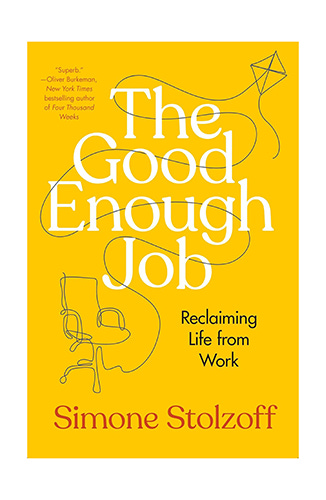
The Good Enough Job: Reclaiming Life from Work
Simone Stozoff; 2023, Portfolio/Penguin
You may be sensing a theme.
Not long ago, I posted two (2!) write-ups about the book Work Won’t Love You Back: How Devotion to Our Jobs Keeps Us Exploited, Exhausted, and Alone. I dedicated well over seven thousand words to that book and its themes of employee exploitation in the name of “loving your job,” the modern culture of overwork, and the systematic undervaluation of mission-driven, artistic, and care-giving endeavors.
And now here we are with The Good Enough Job: Reclaiming Life from Work. It’s more or less about exploitation in the name of “loving your job,” the culture of overwork, systematic undervaluation…etc.
I mean, I hope you are sensing a theme. I’m certainly trying for a theme! This is material that I’ve been thinking about a lot.
“One of the great ironies of the twenty-first century: the reward for professional success is often just more work.”
Whereas Work Won’t Love You Back is a dense, challenging, somewhat difficult book, this one is not that at all. The Good Enough Job is well researched to be sure (and the research is remarkably timely, with the majority of citations1 referencing material less than ten years old). And the arguments it puts forward seem similarly rooted in legitimate academic and journalistic practice.
Obviously, the subject matter in the two books covers some similar ground: discussions of “Fordism” (or Henry Ford’s role in helping codify the modern work environment), collective labor action, the siren call of “status,” the risks of chasing “fulfillment” in work — even good old Karl Marx makes an appearance in each book.
In addition, the books have some structural similarities. They’re both based around a series of case studies; they orbit their arguments around journalistically reported stories of real people. It’s an effective device. It allows context to be built up engagingly — it gives some of the more didactic content a relatable, real-world gravity.
But The Good Enough Job is much lighter weight and much easier to read.
It’s half the length, for one thing, but it also maintains a tighter focus and tries less for a vast-sweep-of-history approach. That said, it’s also a bit shallower and sometimes comes off as a little more…privileged.
Nonetheless, the approach does mean it can be a little more down-to-earth, too. There’s something really practical and grounded about an observation like:
“The office itself is a technology, a tool that ideally helps people get work done. But like any piece of technology, how it’s used matters far more than what it can do. The office can be a nexus of collaboration or a stage for corporate theater. It can be an oasis for deep work or a place where employees demonstrate to their managers how hard they surely must be working.”
Or this:
“When it comes to delineating between work and life, not every worker has the same preferences. Nancy Rothbard, a management professor at Wharton, believes there are broadly two types of workers: ‘integrators,’ people who don’t mind blurring the boundary between work and home, and ‘segmentors,’ people who have a strong desire to separate work from their personal life.”
“Managers should take note…the same policy might not be as effective for two different workers. An integrator might appreciate the freedom of a flexible deadline so they can accomplish the work on their own schedule, but the same flexibility might stress out a segmentor, who prefers clear timelines.”
It’s not generally a book of managerial advice, but that’s pretty good!
And there’s a certain humility to the author’s affect. He admits that if you feel lost for purpose or identity, it makes sense to try and get it from the place you spend most of your time: work. It’s not a dumb impulse!
“I don’t think work is necessarily a bad place to look for a source of identity and meaning. I certainly identify as a writer and derive meaning from the work I produce.”
All the while he notes the risks he feels for himself:
“Unless I over-deliver, my logic goes, unless I continually prove my worthiness, I will somehow fall behind. I’ve adopted the values of capitalism as my own: Growth is progress. Stagnation is death.”
And:
“Even as I chronicled the dangers of conflating our self-worth with our work for this book, I couldn’t help but feel that days where I didn’t add to my word count, interview a source, or edit a chapter were somehow wasted.”
Right? That hits pretty damn close to home, I have to say.
And for the most part, the sense of humility carries through to the subjects of the case studies. One of them denied that his rejection of his successful corporate career was all that high-minded:
“‘When I quit, it was not for time, it was not for a better living, a better pace of life, or work-life balance. It was because I was fucking moody.’”
I liked this passage largely because Stolzoff didn’t have to include it. The story made sense without it. But it humanizes the subject in a meaningful way (and is also just funny).
The humility is certainly not universal, though. One subject who organized a union says:
“And anyone who claims those as their principles is commanded to organize their workplace today.”
Phew. Okay, big guy.
“The expectation that work will always be fulfilling can lead to suffering. Studies show that an ‘obsessive passion’ for work leads to higher rates of burnout and work-related stress. Globally, more people die each year from symptoms related to overwork than from malaria.”
Another theme in the book is the overwork that results, at least in part, from chasing this duality from a job. We all know that working more hours isn’t going to get us what we want, yet it’s so tempting to try and just push through. But the author points out actual recent data. For example:
“A 2014 study of munition workers by Stanford economics professor John Pencavel found that productivity per hour sharply declined after working fifty hours. And Pencavel discovered that those who worked seventy hours didn’t get any more done than those who worked fifty-six hours.”
Amen.
Published in 2023, this book is definitely “post-pandemic” in many ways. For example, it gets into the odd working environments that were often a hallmark of that time.
One case study involves the Google engineer Brandon Sprague, who rather famously lived in a box truck in the Google parking lot for a while. That was pre-pandemic, mind you — it had to be, since the way he could manage this was to use the gym, showers, and restaurants on campus while just sleeping in the truck. Once those closed in lockdown, he had to make a change:
“He kept his truck, but also rented a place on the California coast for a year, where he brought his living-at-work practices to his new working-from-home lifestyle. He continued to work consistent hours each day and only at his desk, which he didn’t use for anything else. ‘When I’m working, I work there,’ he told me. ‘And when I’m not working, I am not there.’”
Reading that, I was taken right back to the strategies and approaches we all had to adopt at that time. I was also reminded that that was a lot harder to do for folks who needed specialized equipment or facilities, even when working from home (or living at work, as it were) was a possibility.
Still, the author pulls a reasonably satisfying message out of this case study:
“Whether or not you would make the same choices as Brandon, for those of us lucky enough to choose how work fits into our lives, the most important thing is that we actively make a choice. If we don’t, work can expand like a gas and fill any available space.”
“A 1962 poll found that 6 percent of people thought meaningful work was important to success at the office. Twenty years later, the number was 49 percent. Today, nine out of ten people are willing to earn less money to do more meaningful work.”
I’ve long been a proponent of calling work what it is: transactional. Stolzoff and I are in hard agreement here:
“Speaking about a job as a transaction may seem crass…But companies already treat work transactionally. They hire employees who add value and fire employees who do not. Losing sight of this creates the conditions for exploitation. I don’t say this as a cynic. Rather, I think a more transactional approach to work liberates both employers and employees…Most importantly, it frees employees to treat work as a living and not as the entirety of their lives.”
Be extremely wary anytime an employer acts as if the relationship isn’t transactional. It’s bullshit. Look, it might also be something more than that, and that’s great! But at the end of the day a job is a business transaction — no matter how dedicated you are, if the company needs to it’ll lay your ass off without thinking twice.
One section of the book is dedicated to the founding and early growth — and eventual unionization — of the company Kickstarter. Initially, this looks like a great example of employees being willing to take less standard remuneration for additional “meaning” in the job:
“They asked employees to buy into this mission, which meant accepting less-than-market-rate salaries and forgoing the stock options that often convince people to assume the risk of joining a startup in its early days. In exchange, employees got to work for a company with a social mission, alongside coworkers with similar values.”
I want to make the point that that doesn’t mean this employment was somehow not transactional. It was! The transaction just included things other than strictly money. To the extent the employee gets to make that decision, that’s great!
But of course the reason this section is in the book at all is precisely because when the company eventually violated this — possibly tacit, but no less real — agreement, it was a betrayal that would not stand with the employees. I mean, they wouldn’t have stood for getting paid less than they’d agreed to, right? So why should they stand by while the company reneges on its cultural agreements?
“The Latin word for business, negotium, literally translates to ‘not-enjoyable activity.’”
Stolzoff definitely seems interested in nuance and complexity. I appreciate that, but he maybe sometimes gets a little equivocal about it all:
“Relying on external markers of success can leave ambitious professionals in any field feeling perpetually unfulfilled. This isn’t to say that ambition and achievement are necessarily bad. But in order to satisfy our souls’ deepest yearnings, there must be alignment between our values and the values of the games we play. We need to make sure our notions of success are truly our own.”
I mean, sure. But I guess that means that if I just really really want to be rich, then awesome, I’m aligned! Hmm. Values don’t really exist in a vacuum, do they? They are not neutral, right? There’s not really anything wrong with the sentiment, but I don’t know; I’m skeptical.
Also, it’s an interesting conclusion that the responsibility for work/life is with the employer not the employee:
“Put simply, the problem with personal boundaries is that they inevitably break. ‘When cultivating a healthy working culture becomes the responsibility of the individual, it will always fail. Full stop,’ writes Anne Helen Petersen. ‘The responsibility for better culture lies with the workplace itself — which [is] uniquely equipped to construct the sort of guardrails that can actually protect employees, particularly those early in their career and frantic to distinguish themselves, from the freight train of work.’”
“This highlights two prerequisites for creating a healthier relationship to work: (1) the structural protections to ensure employees can have a life outside of work; and (2) the cultural will to do so.”
That’s all even despite the fact that much of the book’s argument is how we have to find this balance for ourselves. And that in fact, we should appreciate having to find it:
“Our relationship to work is not fixed, nor should we want it to be. It’s by wrestling with work’s place that we uncover what we care about.”
And:
“To detach our sense of self-worth from our work, though, we must first develop a self that no boss or job title or market has the power to change. In Morrison’s words, ‘You are not the work you do; you are the person you are.’ A good enough job is a job that allows you to be the person you want to be.”
So I guess the conclusion is that it’s all a two-way street. Fair enough. But maybe a little unsatisfying?
“It’s no wonder the message from the top is that workers should work for more than money, when leaders keep the majority of the money for themselves.”
Overall, the narrative is compelling and moves along briskly. The case studies seem well chosen, and the thematic through-lines make sense and work well.
Maybe it’s just a sign that Stolzoff is a first time author, but there are several stories that seem…tangential? Irrelevant? For example, in the otherwise very interesting tale of the founding and initial growth of Kickstarter, he drops in this little anecdote:
“Sure, there was the occasional managerial misstep, like the time CEO Perry Chen hired actors dressed up as dinosaurs to wander around the office for a week in an attempt to infuse some quirkiness in the workplace. (Several employees walked out in protest.)”
Wait, what? Did the CEO have something other than “quirkiness” in mind? Why would people “walk out in protest” over this? I mean, it’s dumb and cringy…but surely something else was going on? We won’t know, the book just moves right along. That kind of thing happens in several places.
Still, there’s an appealing sense that the book itself is a labor of love — that Stolzoff is working through a lot of this stuff for himself, too. I vibe pretty hard with that, given <gesticulates around> what I’m trying to do with Ars Pandemonium.
“Of course, many people love their jobs and still live happy, balanced, and stable lives. But when love and passion become stand-ins for fair pay, fair hours, and fair benefits, workers suffer.”
Ultimately, as similar as this book is thematically to Work Won’t Love You Back, they serve pretty different purposes. This one is tighter and lighter, and much, much less obsessive. But I think it also stands a little less strongly as a true object of its time.
The Good Enough Job is definitely worth reading for anyone who thinks about/struggles with how “fulfillment” and “work” should interact. I suspect that’s everyone who reads Ars Pandemonium. Check it out.
Of course I feel I must criticize this book for the way it actually handles its citations: just like others I have complained about, it has no foot- or end-notes, but gathers the citations in the back, indexed by page number and a little snippet of the relevant text. I don’t know who the hell wants this, but it’s awful. I guess it is the way of things now, though, since almost all mainstream non-fiction seems to do it. Get off my lawn. Sigh.
The dinosaurs were definitely a symptom of something much larger within Kickstarter's culture and labor-management relations: https://www.theverge.com/23732782/kickstarter-union-organizing-good-enough-job-excerpt
Also, now I want (need?) to read this book.